Today November 30, 2025, 03:00 PM
Today November 30, 2025, 03:00 PM
Gary Schuelke looked in the mirror. What looked like a pimple stared back.
He squeezed. To his surprise, a tiny piece of bullet fell out. Another half inch higher and he might have lost an eyeball.
The fragment struck Schuelke, then a San Bernardino police sergeant, during a firefight weeks earlier between police — including Schuelke’s son — and a married couple who murdered 14 people and wounded 22 at a holiday-themed meeting of San Bernardino County workers on Dec. 2, 2015.
Schuelke’s blemish faded. Ten years later, the same can’t be said for memories and places associated with the worst terrorist attack on U.S. soil since 9/11.
The salmon-colored Inland Regional Center where the attack took place remains. But across the street, the golf course where victims gathered is now an Amazon warehouse.
Cars and trucks whisk by the IRC — home then and now to a nonprofit helping the developmentally disabled — on South Waterman Avenue. A decade earlier, a makeshift field hospital filled the street.
For most Americans, Dec. 2 became another notch on a long, bloody and seemingly endless timeline of gun violence that includes more recent massacres in Las Vegas and Uvalde, Texas. Measured by body count, San Bernardino ranks 13th among America’s deadliest mass shootings.
But closer to home, the attack’s tragic echo lingers through memorials, traumatic memories and empty chairs at family gatherings.
These are the stories of how Dec. 2, 2015, unfolded and what came after. They’re based on interviews, media accounts, government documents and a 2016 report by the National Policing Institute and the U.S. Department of Justice’s Office of Community Oriented Policing Services.
Training and fun — at least the promise of it — awaited 80 or so employees of San Bernardino County’s Environmental Health Services division.
As they’d done the past few years, they met in the IRC’s conference room, rented by the county for events like this. The previous year’s training focused on what to do if there’s an active shooter.
Valerie Kallis-Weber, then 58, had been with environmental health for seven weeks. She walked inside just before 8 a.m.
A Christmas tree stood in a corner of the roughly 85-by-40 foot conference room, where rows of tables lined up to a horseshoe-shaped table for department leaders. A buffet-style breakfast of pastries, coffee and orange juice stood at the other end.
Environmental Services’ duties include restaurant inspections, pest control and protecting water quality. The meeting featured a training video, employee awards, a trivia game with gift card prizes and group photos by the Christmas tree.
At 10:37 a.m., 28-year-old Syed Rizwan Farook, a health inspector, got up and left, his bag still on a table. Colleagues thought his abrupt departure seemed odd.
Just before 11, an unscheduled break gave employees the chance to mingle, use the restroom or grab a snack.
Popping sounds erupted outside. Some thought it was fireworks. Others heard gunfire.
A door swung open. Without speaking, a figure wearing all black — a ski mask hiding his face — opened fire.
Some froze, thinking it was a drill like last year. Others sought cover under tables and in restrooms and closets.
The shooter and a smaller, similarly clad person fired more than 100 rounds from two AR-15 semiautomatic rifles.
“‘What kind of training is this? This is craziness,’” Kallis-Weber recalled thinking. “I didn’t realize that shots were fired and it was real.”
Kallis-Weber locked eyes with the smaller figure, who shot her in the shoulder. She also took a bullet in the back.
Farook and his wife, 29-year-old Tashfeen Malik, walked between tables, firing at anyone moving or making a sound. Then they left the bullet-riddled, scream-filled chaos in a black Ford Expedition.
The carnage took less than five minutes.
That morning, San Bernardino police Lt. Mike Madden found himself between meetings. The city’s bankruptcy, which slashed the department’s workforce, left him in charge of the records and dispatch departments.
As a middle manager overseeing civilians, Madden didn’t have to wear his uniform. He still did so to feel like a cop and to help officers in the field who asked for a supervisor. But he lacked the tactical gear patrol officers would have.
Madden, then 48, planned to get gas and a bite to eat when his radio broadcast a report of shots fired, possibly from the empty Santa Ana River basin south of the IRC.
“It’s San Bernardino and even at 10:58 on a Wednesday morning, it’s not uncommon for us to have shots-heard calls in that area,” Madden said. “So it didn’t really catch my attention.”
Seconds later, reports came in of multiple shots fired — possibly from more than one shooter — and multiple victims.
Madden recalled “a lot of contradicting information, a lot of just trying to piece it together.”
“It was one of those things that we’ve got something serious going on there and I need to get there.”
When Madden drove up, he realized he was the first on scene. Taking cover behind his car’s trunk, he surveyed the area.
“It’s almost eerily quiet except for the radio,” he said.
People ran out the front doors — some bloodied — away from him. Madden waved over an unarmed security guard, who said at least one suspect drove away in a black SUV and one or two shooters were still inside.
Before the 1999 Columbine High School shooting in Colorado, law enforcement waited for SWAT to confront a shooter. Now, it fell on the first-arriving officers to neutralize the threat as soon as possible.
Madden and three other San Bernardino cops — Detective Brian Lewis and Officers Brett Murphy and Shaun Sandoval — entered the IRC. Guns drawn, they moved, backs to each other and close enough to touch, in a diamond formation, with one officer looking forward, two guarding the flanks and the fourth protecting the rear.
Just two wore ballistics helmets. Only one held a shotgun. No one had a rifle.
“If you were picking your go team, your dream team, so to speak, to be your entry team, the four of us wouldn’t have been on your roster,” Madden said.
“But hey, guess what? None of us have the luxury of picking the calls. The calls pick us.”
Years before, Madden took part in SWAT’s active shooter training drills. Strobe lights, trip wires, sirens, flashbangs and smoke swarmed the senses as fake suspects fired fake rounds at officers.
“I remember talking to one of my fellow sergeants after going through one of the trainings and we were essentially almost badmouthing the training, saying ‘Oh my God, these guys have lost their minds. It’s over the top,’” Madden said.
It wasn’t over the top in the conference room.
“The lights were off but we were still getting the ambient lighting coming from inside. The strobes were going off from the fire alarms,” Madden recalled.
“There was smoke (at) about eye level and you could not even see the ceiling because it was just filled with permeating smoke. The smoke from the gunpowder was basically burning your nostrils because there was so much gunpowder in the air. The fire alarms were going off.”
So were the fire sprinklers.
“It was essentially raining in the room,” Madden said.
A bullet struck a water main in the acoustic ceiling.
“So water was just gushing out of this water main and it was saturating the ceiling tiles,” Madden said.
“So now you couldn’t see the ceiling, but all of a sudden you just had pieces of acoustic ceiling falling down through the smoke.”
Amid screams and moans, the team forged ahead, walking past the dead and wounded. Some victims grabbed at officers’ legs as they walked by, desperately trying to get their attention.
“Our role at the time had to be locating, isolating and stopping the threat,” Madden said.
Not stopping to help “was a very difficult decision to have to make because there were victims in that room that were still alive, but certainly in tremendous amounts of pain, gravely injured,” he added.
More officers arrived and joined the team in a hallway. Madden and others entered a restroom.
On one wall, “you got like three or four bullet holes and those bullets just traveled straight through,” he said.
“There was blood all over the floor … All of the napkins and toilet paper had been dispensed from all of the rolls and dispensers in the bathroom … Somebody had obviously been trying to triage a gunshot wound in there.”
Officers found a locked stall.
“Bathroom stalls just don’t get locked by themselves,” Madden said. “We’re announcing (and) we’re yelling and the fire alarms are still going off so it’s loud and we’re not getting a response.”
“We kicked the door and there’s three female victims standing on top of a toilet seat, just trying to conceal their feet because they’re thinking we were the suspects.”
That evening, an FBI SWAT officer found a suspicious bag in the conference room.
Left behind by Farook, it held three pipe bombs. Authorities believed the shooters planned to set them off after first responders arrived.
Gary Schuelke’s day began with one hunt and ended with another.
The head of San Bernardino police’s narcotics unit, he and his team started the morning of Dec. 2 in Ontario, tracking a man suspected of smuggling drugs into San Bernardino.
His son had the day off. But instead of running errands or relaxing, San Bernardino police Officer Ryan Schuelke was at the Arrowhead Springs Hotel just north of San Bernardino for active shooter training drills with the SWAT team he hoped to join.
Over the radio, Gary Schuelke heard about a shooting in San Bernardino — not an unusual call, given that San Bernardino at the time had one of the nation’s highest violent crime rates per 100,000 people.
More information came in: active shooter, multiple victims.
“That’s when I decided ‘Let’s get out of here and let’s head to the city to see if we can help out,’” Gary Schuelke said.
Ryan Schuelke arrived at the IRC before his father. Law enforcement swarmed the scene, including San Bernardino County probation officers and others who carried out victims — made slippery by sprinkler water — using chairs and blankets or by hand.
A senior officer told Ryan Schuelke to talk to people leaving the building and see if they needed help or knew anything about the shooting. He saw two dead bodies outside.
“I was kind of like ‘All right, this is real. This is bigger than normal,’ ” said Ryan Schuelke, who had been a cop for about a year.
Most of the people he spoke with gave unhelpful or panicked information. Except for one.
Calm, unlike the others, he told Ryan Schuelke he thought his co-worker, Syed Farook, might be the shooter. Ryan Schuelke shared the name with his dad, whose plainclothes officers routinely tracked suspects.
“So that was my mindset,” Gary Schuelke said. “We’re going to hunt these folks down.”
He gave his son a choice.
“‘Hey, do you want to stay here and be a scene guy? You want to be a perimeter guy? Or do you want to go and help us track these people down?’ ”
“And obviously, being the warrior that he is, he says ‘I want to go with you.’ ”
They left in Gary Schuelke’s silver Nissan Pathfinder.
In the back was an AR-15.
Police searched for Farook’s address and told the media about the vehicle seen leaving the IRC. Calls poured in, including a tip about an SUV with Utah license plates.
It was registered to Enterprise Rent-A-Car, which rented Farook the vehicle. Gary Schuelke’s team headed to the Redlands townhouse Farook and Malik shared with their six-month-old daughter and Farook’s mother.
On the way, Gary Schuelke told his son to grab the AR-15. Ryan loaded the rifle in the front seat.
The SUV left just as the narcotics team arrived. They followed it through the city en route to the 10 Freeway as narcotics Officer Nicholas Koahou flagged down Redlands police Sgt. Andy Capps, who was in the neighborhood on an unrelated call.
Capps took off after the SUV, which exited the 10 at Tippencanoe Avenue in San Bernardino and headed north. As other police agencies joined the pursuit, the plan was for Capps — other pursuing cops were in civilian-looking cars — to stop the vehicle.
He switched his emergency lights on, but the SUV didn’t stop. Capps saw the driver and passenger putting on vests.
The SUV turned east onto San Bernardino Avenue. Its rear window shattered as bullets flew toward cops.
“I hear a loud bang and I see Andy’s car kind of swerve to … the left, and I could tell that the (suspects’) rear windshield was gone,” Ryan Schuelke said.
About four hours after the attack, the SUV slammed on its brakes near Richardson Street in a neighborhood roughly two miles from the IRC.
Farook came out shooting as Malik fired from inside. Using the Pathfinder’s doors and engine block as cover, the Schuelkes — about 80 yards from the SUV — joined other police in returning fire.
“I was pissed. I was mad. I wanted to get in the fight,” Gary Schuelke said. “I wanted to stop this person from shooting at us.”
Leaving the Pathfinder, Ryan Schuelke said he “couldn’t hear anything at first.”
“While I’m trying to engage Syed, all of a sudden I start hearing whizzing by my head and then cracking on a loud wall.”
“I don’t hear anything else other than that … (My) body just instinctively let me know that I was being shot at by” Malik.
He stopped shooting at Farook and redirected his fire at Malik. He saw two shots strike her. Malik’s shoulders pitched forward as she bent at the waist and fell to her left and out of sight.
He moved to his dad, who was taking cover behind a wall, and handed him the AR-15. As he shot, Gary Schuelke saw Farook buckle at the waist and fall back.
“Once he got on the ground, I stopped shooting and was just watching to see what he was doing,” Gary Schuelke said. “I see him bring his right leg up like he’s going to try and stand up, so I put my sight on him and fired some more rounds, hoping to keep him from getting up.”
“I look up and all I can see is a pair of hands. No face, no head, no nothing. Just hands coming up in the back window … that was Tashfeen shooting out the back window at us.”
During the firefight, an officer next to Gary Schuelke fired a 12-gauge shotgun.
“I remember going, ‘Oh man’ in my left ear, and I had some hearing loss in my left ear from it,” Gary Schuelke said. To this day, that ear has tinnitus; the other has slight hearing loss.
Gunshots faded to silence. Inside the SUV lay Malik’s lifeless body, clad in tactical gear, with a rifle strapped to her chest.
“When they called the cease fire, that’s when the smells were more apparent,” Ryan Schuelke said. “That burnt gunpowder.”
A motorized battering ram known as “the Rook” probed the vehicle in case it was booby trapped. Later that day, the Schuelkes walked up to the SUV.
“The most eerie thing about it is the windshield wipers were going” back and forth, Gary Schuelke said.
Twenty-four law enforcement officers from various agencies fired at least 440 rounds from rifles, shotguns and handguns. Farook and Malik discharged at least 81 in a firefight that lasted about five minutes.
Farook was shot 27 times. At least 15 bullets hit Malik. Two wounded cops survived.
Inside the SUV, police found more than 2,300 rounds of ammunition, medical supplies and a trigger device for the pipe bombs.
Afterward, the idea that father and son could both have died — or watched the other die — didn’t sit well with Gary Schuelke’s superiors.
“It’s one of my most proud moments as a law enforcement officer, being in there with my son and doing what we did,” he said.
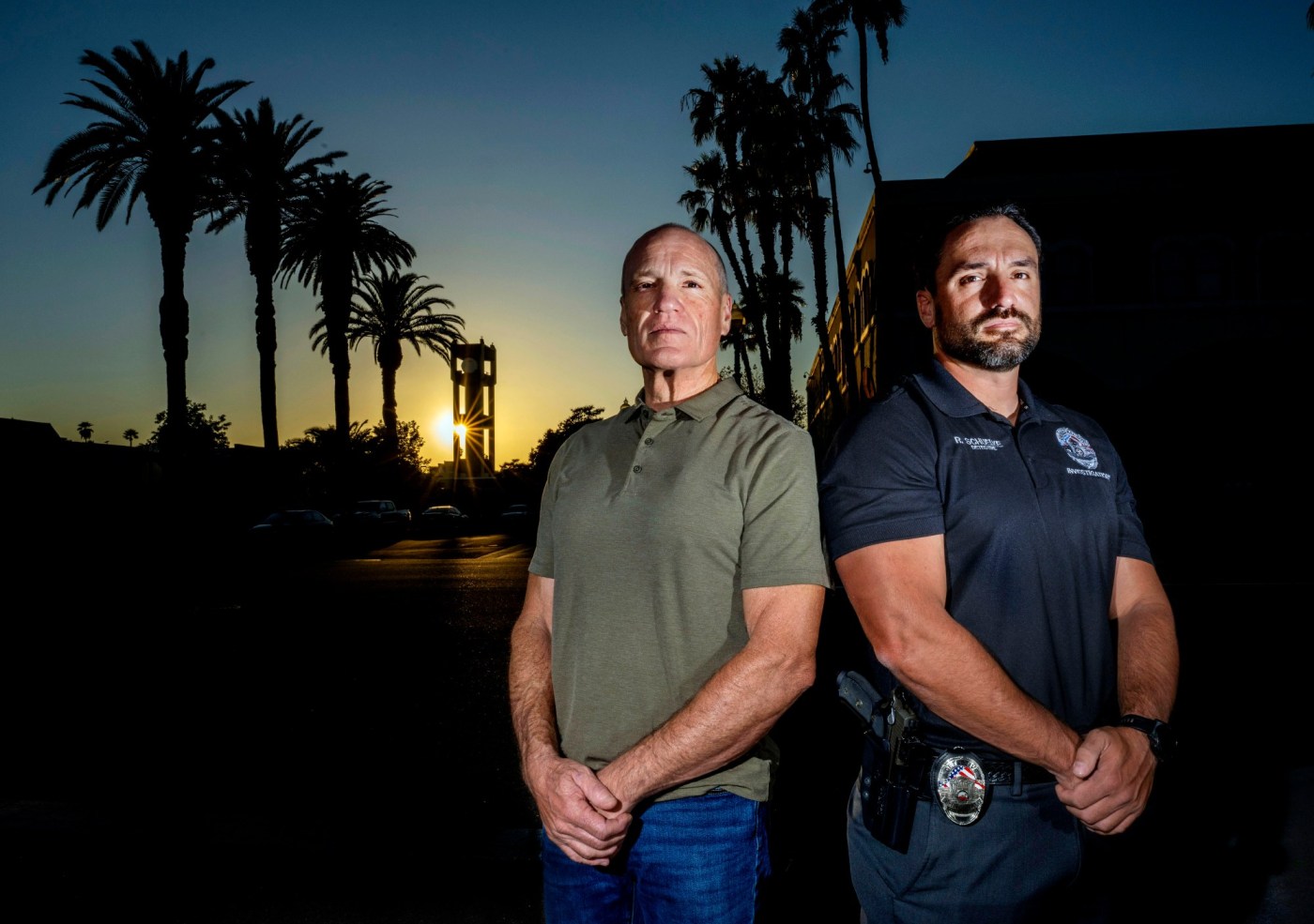
Now 55, Gary Schuelke retired in 2022 after 30 years on the force. He has traveled the country with survivors of the attack and fellow officers to talk with law enforcement agencies about the lessons of that day.
After retiring in 2018, Madden, now 58, became a private contractor for the Institute for Intergovernmental Research, a nonprofit organization that helps law enforcement. He teaches under the State and Local Anti-Terrorism Training Program, speaking with first responders across the U.S. about what to do in a Dec. 2-like scenario.
Ryan Schuelke, now 36 and with Cathedral City police, has no regrets about his actions that day.
“I don’t really know that I would have done anything differently,” he said. “I was glad I jumped in the car with him. I wouldn’t take that back for anything.”