Today November 20, 2025, 12:33 AM
Today November 20, 2025, 12:33 AM
One approach to solving a huge problem such as homelessness in Los Angeles County is to tackle it piece-by-piece, one unhoused group at a time.
That’s the thinking expressed by the Los Angeles County Board of Supervisors on Tuesday, Nov. 18, which created a plan to help homeless veterans get to shelters and permanent housing quicker by slashing red tape and urging county departments to work closely with state and federal service providers.
“I think it is a collective sin that people feel — that those who put their lives on the line for us now find themselves sleeping on our streets,” said Fourth District Supervisor Janice Hahn, who authored the plan that was approved around 8:15 p.m. Tuesday by a 4-0 vote, with Third District Supervisor Lindsey Horvath absent.
As is often the case with L.A. County services, the supervisors talk a good game, but the county’s bureaucracy often fails to score. Roadblocks, paperwork and working in silos combine to create obstacles. Hahn has said that bureaucracy has slowed or blocked access to housing for veterans.
The goal, as expressed by Jim Zenner, the county’s director of Military and Veterans Affairs, is to end veteran homelessness by 2028. Hahn called that “ambitious” but something that “could be within our reach.”
Zenner said the key is working together with state agencies and in particular, coordinating closely with the U.S. Department of Veterans Affairs (VA). “We believe we can get it done. We are going to get it done,” Zenner told the board.
One huge problem is the inability to track where the unhoused veterans are, and where matching housing should be.
“We need to identify where veterans want to live,” said Hahn. “This (action) ensures we build housing where it is actually needed.”
Other problems listed by Hahn included fragmented delivery of services; getting into housing made tough due to confusing, uncoordinated entry points; inconsistent eligibility requirements; and documentation challenges that slow or block access to housing.
Currently there are 3,050 veterans in the county without a permanent home. That number is down about 25% from 2021, Hahn said.
Also, revitalized efforts from the county and VA accounted for a 22.9% drop in veterans homelessness from 3,878 in 2023, to 2,991 in 2024. There was a slight increase in 2025, and Hahn’s office said that the new approved action plan is designed to continue the decrease.
About 72,308 people are living without a permanent shelter in L.A. County, according to the point-in-time count done in mid-February 2025. According to the count, there was a decrease in unsheltered homeless individuals of 9.5% from the previous year, and a drop of 14% from two years ago.
“Now, I believe ending veteran homelessness is within our reach,” Hahn said. Hahn’s office has pointed out that county systems haven’t always made it easy for veterans to find help.
The biggest cohort of homeless veterans are Black and Latino veterans in high-need communities such as Compton, Inglewood, South Gate and East Los Angeles, Hahn reported. These areas have high unemployment, elevated poverty and disability rates, as well as limited access to VA health services.
“It is my goal that with this new framework, we can break down the bureaucratic barriers that have made it too hard for veterans to get the help they need, and ensure the entire county system and our partners in the state and the (federal) VA are finally rowing in the same direction,” Hahn said.
Hahn’s office reported that veterans often face a maze of county departments, complicated VA processes, and inconsistent access point for help.
The action plan will attempt to remove barriers and speed up access to shelters and permanent housing:
• Having to prove a homeless individual is in fact a veteran can take reams of paperwork and cause months of delays. The action plan directs Zenner to work out an agreement with the U.S. Department of Veterans Affairs to allow veterans to self-refer as a veteran, so they can get into federal housing programs quicker and make the process run smoothly, Hahn said.
• Quite often, homeless veterans in shelters find employment. While that’s a good thing, the county doesn’t always track that. Hahn’s motion wants to find out where they are working, then open up veteran housing near their workplaces. “That ensures we build housing where it is actually needed,” Hahn said.
• Healthcare issues often set up a revolving door from the streets, to hospitals, to jails, and back to the streets. Apparently, the county’s healthcare system isn’t helping. The motion will attempt to better coordinate county healthcare services for mental health and substance abuse with the VA.
• Homeless veterans don’t want to be separated from their pets. But having a pet can prevent them from getting into permanent housing or shelters. That is another barrier the plan intends to remove.
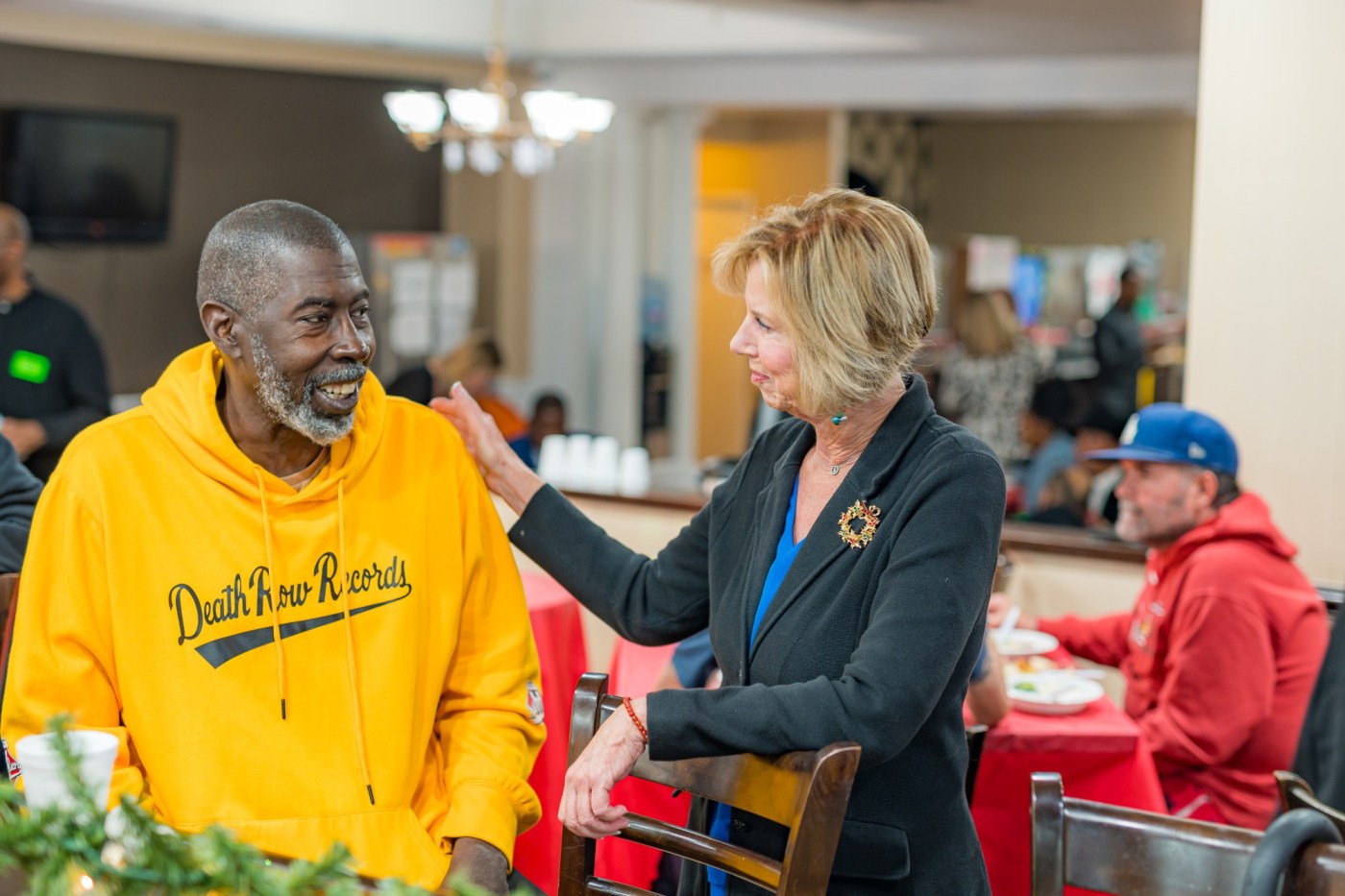
Hahn touted her success at turning an abandoned motel in San Pedro into the Louis Dominguez Veterans Resource Center. About 60 veterans live temporarily there, while receiving services and have moved out to permanent housing on their own.
“These men just wanted to come inside, have a clean, safe place to say. They’ve turned their lives around and found employment or gone back to school,” Hahn said, citing the ability of veterans to find their way out of homelessness.
Fifth District Supervisor Kathryn Barger noted that new veterans housing has been built on VA property in Westwood. Also, she wanted the new action plan to coordinate with homeless services provided by the City of Los Angeles.
“The word homeless and veterans should never be used in the same sentence,” Barger said.
Veterans experiencing homelessness can call: 310-268-3350, Monday-Friday, 7:30 a.m. to 4 p.m. For after hours support, dial 2-1-1.