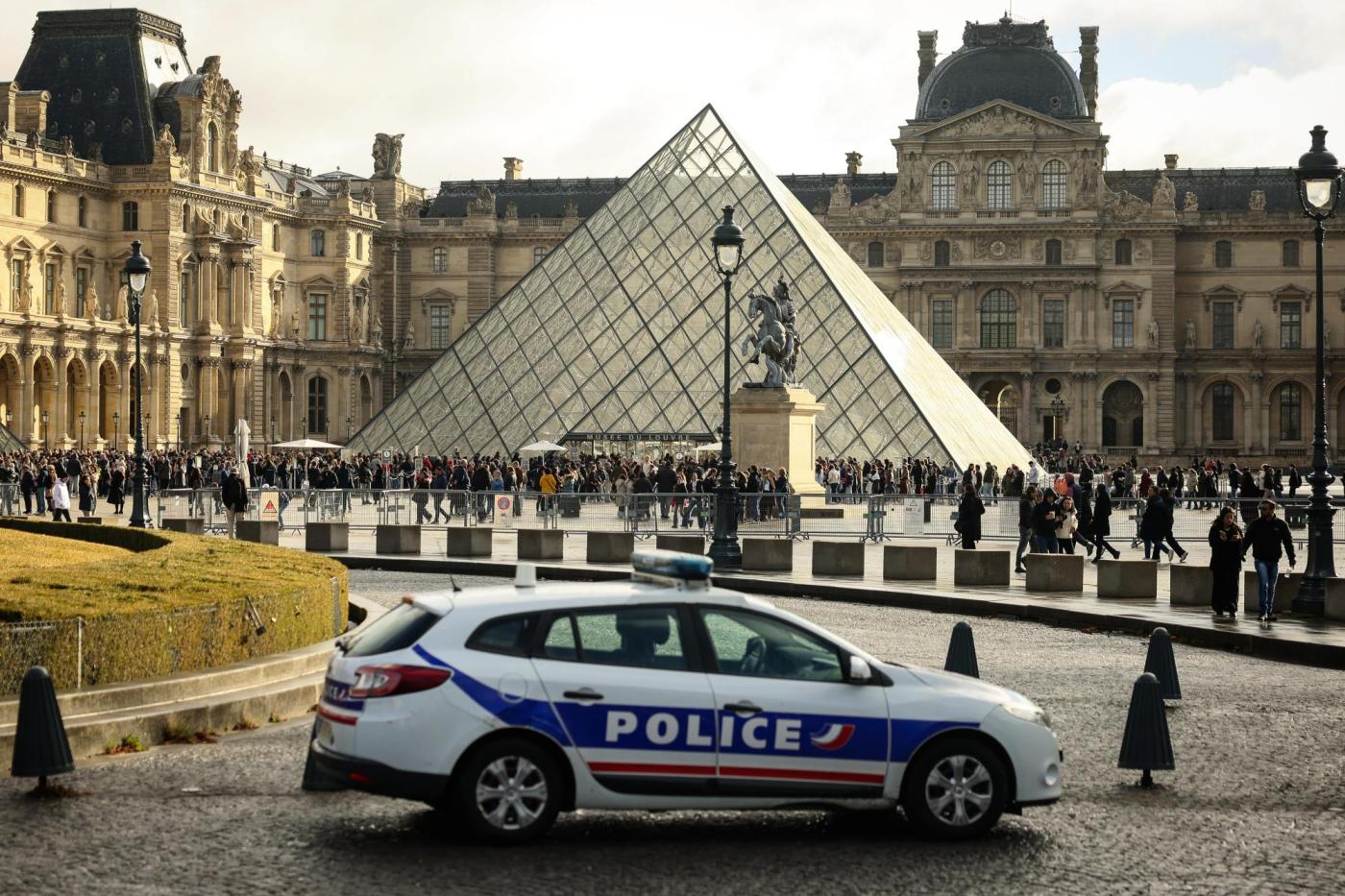
Today November 28, 2025, 03:45 PM
Today November 28, 2025, 03:45 PM
By JOHN LEICESTER, Associated Press
PARIS (AP) — A man arrested by French police earlier this week is thought to be the fourth member of the team that stole France’s crown jewels in a brazen heist from the Louvre Museum, the Paris prosecutor said Friday, meaning that the entire gang is now believed to be in custody.
Prosecutor Laure Beccuau, whose office is heading the investigation, said the 39-year-old man has a criminal record, with six previous convictions.
He has now been handed preliminary charges of robbery by an organized gang, punishable by 15 years imprisonment, and criminal conspiracy, which can carry a 10-year sentence if he is convicted for his suspected role in the stunning Oct. 19 theft at the world’s most-visited museum. The robbery gang’s haul of loot was worth an estimated 88 million euros ($102 million) — a monetary value that didn’t include their huge historical value to France.
The prosecutor’s statement didn’t say what role, exactly, the man is thought to have played in the daylight heist, carried out with angle grinders, a freight lift and subterfuge, with robbers dressed as workers in bright vests.
The robbery is believed to have been the work of a four-person team — with two people breaking into the museum’s Apollo Gallery where the jewels were displayed and then being whisked away on motorbikes by two associates who waited outside.
The haul hasn’t been recovered. It includes a diamond-and-emerald necklace Napoleon gave to Empress Marie-Louise, jewels tied to 19th-century Queens Marie-Amélie and Hortense, and Empress Eugénie’s pearl-and-diamond tiara.
The robbery has focused attention on security at the Louvre, the world’s most-visited museum.
The thieves took less than eight minutes to force their way into the museum and leave, using a freight lift to reach the building’s window. Footage from museum cameras showed that the two who broke into the ornate Apollo Gallery used grinders to cut into jewelry display cases.
The emerald-set imperial crown of Napoleon III’s wife, Empress Eugénie, containing more than 1,300 diamonds, was later found outside the museum.