Today December 25, 2025, 01:34 AM
Today December 25, 2025, 01:34 AM
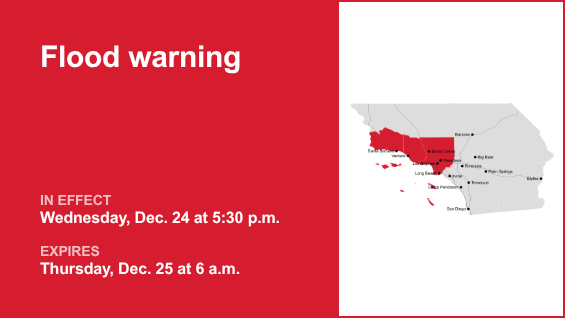
Los Angeles County is under an updated flood warning which was released by the National Weather Service on Wednesday at 6:16 p.m. The warning is in effect until Thursday Dec. 25, at 6 a.m.
The NWS Los Angeles/Oxnard CA said, “Flooding caused by excessive rainfall is expected. Very heavy rains that occurred earlier in the mountains continue resulting in water drainage into the Antelope Valley, causing flooding even where it is not raining for the Antelope Valley county.”
“Flooding of rivers, creeks, streams, and other low-lying and flood-prone locations is imminent or occurring. Several structures are flooded. Numerous roads remain closed due to flooding. Streams continue to rise due to excess runoff from earlier rainfall. Low-water crossings are inundated with water and may not be passable. Expect many areas of slow moving or standing water. It will take several hours for all the water from the earlier rain to work through local drainage systems in urban areas. Local media have reported water rescues,” according to the NWS. “Avoid flooded roads. Be aware of rock slides, mudslides, and possibly debris flows.”
Updates on road closures can be found on CalTrans’ website or mobile app or by calling 800-427-7623.
For “considerable or catastrophic” hazards, emergency alerts will be sent to all enabled mobile phones in the area. To monitor lesser risk, residents are advised to sign up for county alert systems and to monitor agencies’ social media. How to sign up for alerts in your area:
LA County
Orange County
Riverside County
San Bernardino County
If you’re in an area at risk of flooding, sandbags can be one line of defense. County fire departments typically offer a limited supply of free sandbags for residents of their nearby communities. You should bring your own shovel to fill your bags, and be prepared to show proof of residency.
Sand and sandbags can also be purchased at many home improvement and hardware stores.
Here are links of locations that might have sandbags in your area:
Los Angeles County https://dpw. Lacounty. Gov/dsg/sandbags/
Orange County https://ocfa. Org/AboutUs/Departments/OperationsDirectory/Sandbags. Aspx
San Bernardino County https://sbcfire. Org/sandbags/
Riverside County https://rvcfire. Org/resources/fire-stations
Not sure how to fill your sandbags? Watch the how-to video, provided by the City of Seal Beach.
A flash flood warning is issued when a flash flood is either imminent or already occurring. In flood-prone areas, it’s crucial to move immediately to higher ground. A flash flood is a sudden and violent inundation that can develop within minutes to hours, and it can even happen in areas not currently experiencing rainfall.
A flood warning is declared when flooding is on the verge of happening or is already underway.
A flood advisory is released when flooding is not expected to reach a severity level necessitating a warning. Nonetheless, it can still cause considerable inconvenience and, without exercising caution, potentially lead to situations that threaten life and/or property.
A flood watch is issued when conditions are favorable for flooding. It does not mean flooding will occur, but it is possible.
Floods can pose a significant threat, especially if you live in a flood-prone area or find yourself camping in a low-lying region. To ensure your safety, the NWS offers essential flood safety guidelines:
Move to higher ground:
If you reside in a flood-prone region or are camping in low-lying terrain, the first step to safety is relocating to higher ground.
Follow evacuation orders:
If local authorities issue an evacuation order, heed it promptly. Prior to leaving, secure your home by locking it.
Disconnect utilities and appliances:
If time allows, disconnect your utilities and appliances. This reduces the risk of electrical hazards during flooding.
Steer clear of flooded basements and submerged areas:
Avoid basements or rooms submerged in water with electrical outlets or cords. Preventing electrical accidents is crucial.
Swift evacuation for your safety:
If you notice sparks or hear buzzing, crackling, snapping, or popping sounds, evacuate without delay. Do not enter water that may carry an electrical charge.
Stay away from floodwaters:
Never attempt to walk through floodwaters. Even just 6 inches of swiftly moving water can forcefully knock you off your feet.
Seek high ground if trapped:
In the event you become trapped by moving water, make your way to the highest point available and contact emergency services by calling 911.
During periods of intense rainfall, the risk of flooding increases, particularly in low-lying and flood-prone areas. It is imperative to avoid driving through any water on the road, even if it seems shallow. According to the NWS, most cars can be swept away by just 12 inches of rushing water. Prioritize your safety by staying informed and prepared.
Heavy rainfall may lead to flooding if prolonged or if there is excessive runoff. Excessive runoff can be a result of saturated ground and/or rainfall intensity. Follow these recommendations from the NWS to stay safe in heavy rain:
Beware of rapid water flow:
In heavy rain, refrain from parking or walking near culverts or drainage ditches, where swift-moving water can pose a grave danger.
Maintain safe driving distances:
The two-second rule for following distance is your ally in heavy rain. Extend it to four seconds to ensure safe spacing in adverse conditions.
Reduce speed and drive cautiously:
On wet roads, reducing your speed is crucial. Ease off the accelerator gradually and avoid abrupt braking to prevent skidding.
Choose your lane wisely:
Stick to the middle lanes to minimize the risk of hydroplaning. Outer lanes are more prone to accumulating water.
Visibility matters:
Enhance your visibility in heavy rain by activating your headlights. Be particularly vigilant for vehicles in blind spots, as rain-smeared windows can obscure them.
Watch out for slippery roads:
Be extra careful during the first half hour after rain begins. Grime and oil on the road surface mix with water to make the road slippery.
Keep a safe distance from large vehicles:
Don’t follow large trucks or buses too closely. The spray created by their large tires reduces your vision. Take care when passing them as well; if you must pass, do so with caution.
Mind your windshield wipers:
In the face of heavy rain, these precautions can make a significant difference in ensuring your safety on the road. Remember to stay informed about weather conditions and heed guidance from local authorities for a secure journey.
For more local weather alerts, visit our Weather Advisory page