Today November 17, 2025, 03:47 PM
Today November 17, 2025, 03:47 PM
The Chargers reached their bye week with so many inconsistencies in their play that it was difficult to know where to start to dissect them. Their 35-6 loss Sunday to the Jacksonville Jaguars was one game in which they actually were consistent from beginning to end. Consistently bad, that is.
Here’s what we learned, what we heard and what comes next for the injury-plagued Chargers, whose 7-4 record and second-place standing in the AFC West should be good news but really isn’t going into a week in which they must rest and regroup before returning to action Nov. 30:
It’s easy to pin the Chargers’ inconsistent play on injuries, especially to their offensive line. They had an answer for Rashawn Slater’s absence because of a season-ending injury when they shifted Joe Alt to left tackle from right tackle, but that left a void at right tackle.
Alt’s season-ending injury wreaked further havoc, which was compounded by nagging injuries to right guard Mekhi Becton, and tackles Bobby Hart and Trey Pipkins III. Left guard Zion Johnson and center Bradley Bozeman are the only two offensive linemen to start all 11 games.
Coach Jim Harbaugh gave Trevor Penning, acquired Nov. 4 from the New Orleans Saints, a chance to start at left tackle and the results fell short of expectations. Way short, in fact. Becton was in and out of the game with an injury. Jamaree Salyer was in and out as his replacement.
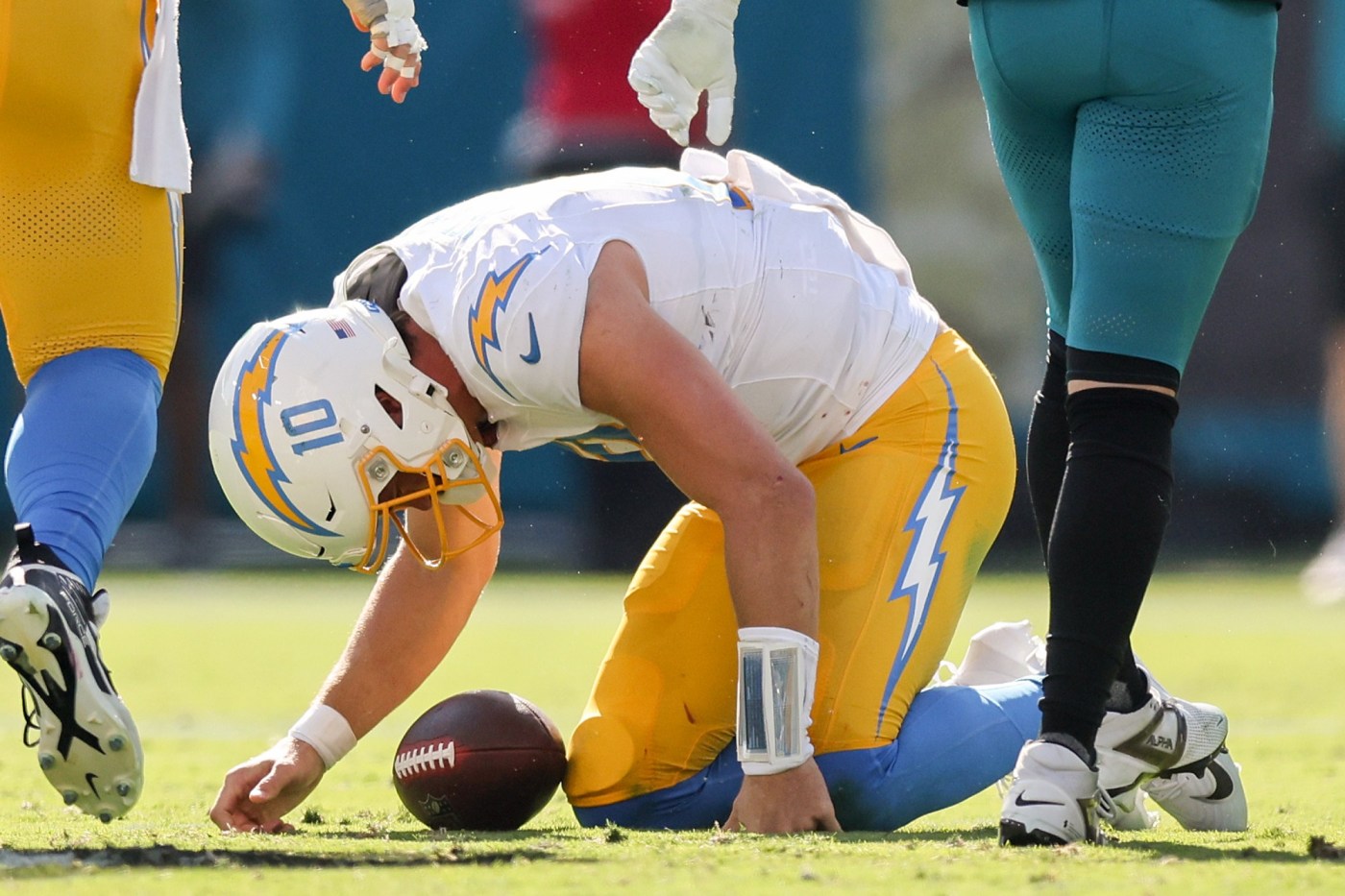
To be fair, the Jaguars played a key role in the Chargers’ offensive misery, pressuring quarterback Justin Herbert into a career-low 81 yards passing and forcing him to be checked for a concussion after an illegal hit near the end of the first half. But the Chargers did themselves no favors.
“It’s not the easiest thing,” Johnson said of the shuffling and re-shuffling of the deck on the O-line. “But I think we have guys in this room who are up for the challenge. We’ve got to take a hard look at the tape, see where we can improve technique-wise and where we can raise the level of execution.”
The Chargers’ loss to the Jaguars couldn’t be blamed solely on an ineffective offensive line and an unproductive quarterback. Their defense was on the field for far too long in the second half, as safety Derwin James Jr., pointed out, which led to fatigue and tackling and coverage issues.
Jacksonville was the aggressor on both sides of the football, and especially offensively. The Jaguars took it to the Chargers, who were back on their heels to start the second half and never recovered. The Jaguars’ first two possessions of the second half yielded touchdown drives of 11 and 16 plays.
By game’s end, the Jaguars held a mammoth edge in time of possession, 37:55-22:05, one of a number of unsettling statistical abnormalities for the Chargers. The Jaguars ran 69 plays to only 45 for the Chargers. The Jaguars rushed for 192 yards and the Chargers had only 42.
“We can’t allow people to play like that,” James said.
The Chargers’ ground game was ground into dust, with Herbert scrambling three times for a team-leading 21 yards. Kimani Vidal injured his thigh, but returned to the game after a break on the sideline, and gained a season-low 13 yards on five carries. Overall, the Chargers averaged 2.6 yards per rush.
“We just never really got set up,” Herbert said. “We just never got in rhythm or comfortable. It starts with the run game and we weren’t able to do that. It’s on me to do a better job of getting those completions and finding those easy routes where we can convert on third down, which we did a poor job of (Sunday).
“We just weren’t in rhythm.”
Raiders Week is actually two weeks since the Chargers don’t play again until Nov. 30, when they host the Las Vegas at SoFi Stadium. They could have running back Omarion Hampton back from injured reserve because of an ankle injury, which should diversify their offense.
The Chargers end the season with games at home against the Philadelphia Eagles (8-2), at the Kansas City Chiefs (5-5), at the Dallas Cowboys (3-5-1 going into Monday night’s game against the 2-7 Raiders), at home against the Houston Texans (5-5), and at the Denver Broncos (9-2).
Realistically, they need to win at least three of their final six to advance to the playoffs for the second season in a row under Harbaugh, and even then it might take four victories to make it happen. It was always going to be a tough ending to the season, but now it seems even tougher.