Today November 21, 2025, 12:14 PM
Today November 21, 2025, 12:14 PM
By GERALD IMRAY, Associated Press
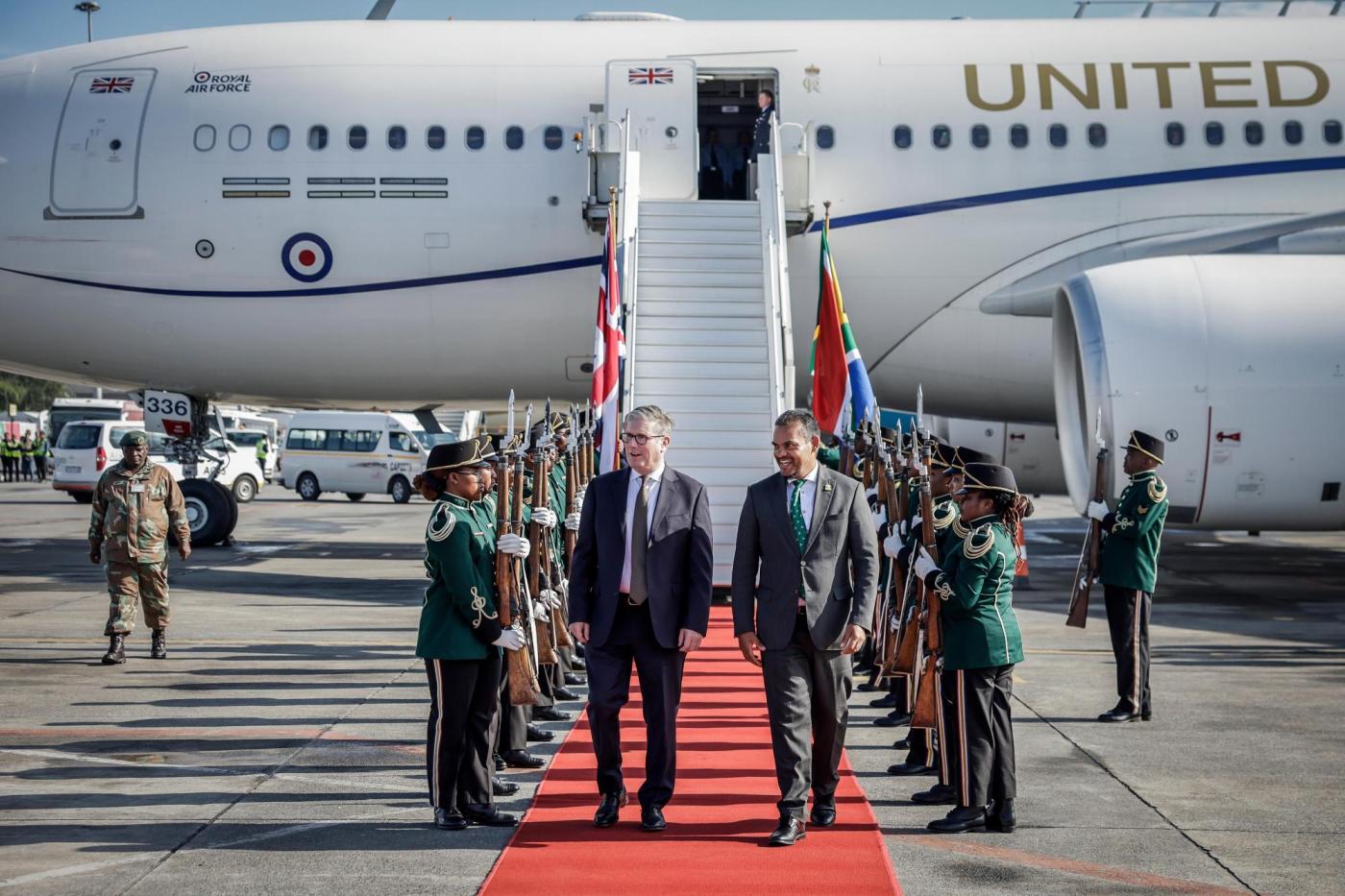
JOHANNESBURG (AP) — World leaders arrived Friday for a historic first Group of 20 summit in Africa that aims to put the problems of poor countries at the top of the global agenda but has been undermined by a rift between host South Africa and the United States over a Trump administration boycott.
The weekend summit in Johannesburg will be attended by delegations from 18 of the world’s richest and top developing economies — minus the U.S., which has branded South Africa’s hosting a “disgrace ” and won’t participate in the talks.
The boycott by the world’s biggest economy and founding G20 member was ordered by U.S. President Donald Trump over his claims that majority-Black South Africa is persecuting its white Afrikaner minority.
Strong U.S. opposition threatens to undercut South Africa’s chosen agenda for the summit, where the host wants to focus world leaders’ attention on issues like the impact of climate change on the developing world, debt burdens for poor countries and widening global inequality.
South African President Cyril Ramaphosa responded: “We will not be bullied. We will not agree to be bullied.”
A leaders’ declaration is the traditional climax of G20 summits and details any broad agreement reached by the members, though it’s not a binding document. The bloc has often struggled to put words into action due to the different priorities of members like the U.S., China, Russia, India and countries in Western Europe.
The G20 has expanded to 21 members, 19 nations plus the European Union and African Union, and is meant to bring rich and poor countries together to tackle problems, especially around the global economy.
Leaders of the United Nations, the World Bank and other international institutions also traditionally attend the summits as guests and U.N. Secretary-General António Guterres will be in Johannesburg.
The U.S. boycott of this G20 is viewed as an example of Trump’s criticism of multinational organizations, having pulled the U.S. out of the Paris climate agreement and the World Health Organization.
But other leaders have traveled to Africa’s most developed economy hoping to find common ground, especially around new trade deals in the wake of U.S. tariffs.
“The African states are searching for partnerships,” German Chancellor Friedrich Merz said, “and so I will go to Johannesburg in any case and hold talks there. … I expect that we will return to Germany with good results.”
While it often operates in the shadow of the Group of Seven richest democracies, G20 members together represent around 85% of the world’s economy, 75% of international trade and more than half the global population.
“The G20 is such an important gathering, it’s the most important gathering for which Australia is a member,” said Australian Prime Minister Anthony Albanese, who said he’d planned bilateral meetings with leaders of the EU, India and Germany on the sidelines of the Johannesburg summit. Albanese noted one in four jobs in Australia depended on trade with partners like those in the G20.
The EU announced a new critical minerals agreement with South Africa in Johannesburg this week and European Commission President Ursula von der Leyen said the G20 was an opportunity to “double down” on their partnership.
British Prime Minister Keir Starmer would announce a new commercial deal for a British rail company to assist South Africa with the reform of its rail network, the U.K. government said.
“Working with international partners to deliver jobs and opportunity at home is a one-way ticket to growth,” Starmer said.
Trump is not the only major world leader to miss the summit. China’s Xi Jinping won’t be in Johannesburg after cutting back on his international travel, and Russian President Vladimir Putin won’t travel as he is the target of an International Criminal Court arrest warrant over his alleged involvement in abducting children from Ukraine.
South Africa, as a member of the court, would be expected to arrest Putin if he set foot on South African territory.
But China and Russia will still send government delegations, leaving the U.S. as the only one of the 19 countries in the G20 not represented.
Chinese Premier Li Qiang, who is Xi’s No. 2, used his trip to the G20 to stop off in Zambia to sign a $1.4 billion, three-country railway refurbishment agreement that will revive a Cold War-era rail line. That will help expand the already extensive influence of China — the U.S.’s biggest economic rival — in Africa and increase its access to critical minerals.
Some analysts say developing world countries, especially in Africa, could take the U.S. boycott as evidence of their need to further increase ties with others, especially China.
“This isn’t necessarily negative. It can catalyze more diverse leadership in global governance,” said professor Narnia Bohler-Muller, an international law and democracy researcher in South Africa.
Ramaphosa, who will chair the summit, put the U.S. boycott more bluntly: “Their absence is their loss,” he said.