Today December 25, 2025, 04:54 PM
Today December 25, 2025, 04:54 PM
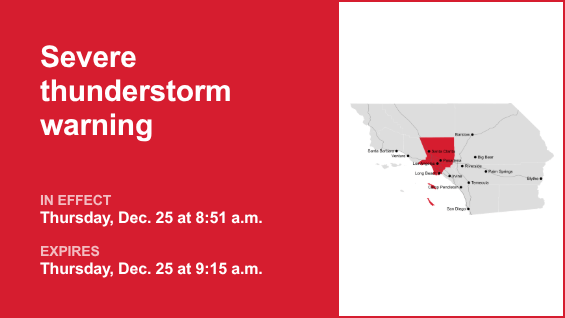
Los Angeles County is included in a severe thunderstorm warning released by the National Weather Service on Thursday at 8:51 a.m. The warning is in effect until 9:15 a.m.
Residents should prepare for wind gusts of up to 60 mph.
“At 8:51 a.m., a severe thunderstorm was located over eastern Malibu, moving north at 10 mph,” the NWS Los Angeles/Oxnard CA said. “Expect damage to roofs, siding, and trees.”
Locations impacted by the warning include Eastern Malibu, Topanga State Park, Pacific Palisades and Topanga Canyon Road through the Santa Monica Mountains.
According to the NWS, “Remain alert for a possible tornado! Tornadoes can develop quickly from severe thunderstorms. If you spot a tornado go at once into the basement or small central room in a sturdy structure. For your protection move to an interior room on the lowest floor of a building.”
Updates on road closures can be found on CalTrans’ website or mobile app or by calling 800-427-7623.
For “considerable or catastrophic” hazards, emergency alerts will be sent to all enabled mobile phones in the area. To monitor lesser risk, residents are advised to sign up for county alert systems and to monitor agencies’ social media. How to sign up for alerts in your area:
LA County
Orange County
Riverside County
San Bernardino County
If you’re in an area at risk of flooding, sandbags can be one line of defense. County fire departments typically offer a limited supply of free sandbags for residents of their nearby communities. You should bring your own shovel to fill your bags, and be prepared to show proof of residency.
Sand and sandbags can also be purchased at many home improvement and hardware stores.
Here are links of locations that might have sandbags in your area:
Los Angeles County https://dpw. Lacounty. Gov/dsg/sandbags/
Orange County https://ocfa. Org/AboutUs/Departments/OperationsDirectory/Sandbags. Aspx
San Bernardino County https://sbcfire. Org/sandbags/
Riverside County https://rvcfire. Org/resources/fire-stations
Not sure how to fill your sandbags? Watch the how-to video, provided by the City of Seal Beach.
Each year, lightning strikes the United States approximately 25 million times, mostly during the summer. It claims the lives of about 20 people annually, according to the NWS. The threat of lightning becomes more pronounced as thunderstorms draw nearer, peaking when the storm is directly overhead and gradually waning as it moves away.
To protect yourself during a thunderstorm, take these recommendations into consideration:
Lightning safety plan:
Indoors safety measures:
Wait for the all-clear:
When indoor shelter isn’t available:
If you find yourself outdoors without access to indoor shelter during a thunderstorm, take these steps to maximize your safety:
In summary, when facing the threat of lightning, preparedness and vigilance are your best allies. By following these guidelines, you can significantly reduce the likelihood of lightning-related incidents and prioritize your safety.
Rain can turn roads into hazards. Stay informed and follow these tips from the NWS to ensure safety during heavy rainfall:
Beware of swollen waterways:
Avoid parking or walking in close proximity to culverts or drainage ditches, as the swiftly moving water during heavy rain can potentially carry you away.
Maintain safe driving distances:
Use the two-second rule to maintain a safe distance from the car in front of you and allow an extra two seconds in heavy rain.
Reduce speed and drive cautiously:
On wet roads, slowing down is paramount. Gradually ease off the accelerator and avoid abrupt braking to prevent skidding.
Choose your lane wisely:
Stick to the middle lanes on multi-lane roads to minimize the risk of hydroplaning, as water tends to accumulate in outer lanes.
Prioritize visibility
Turn on your headlights and be careful of other vehicles to the rear and in blind spot areas as they are especially difficult to see through rain-spattered windows.
Watch out for slippery roads:
The first half-hour of rain is when roads are slickest due to a mix of rain, grime, and oil. Exercise heightened caution during this period.
Keep a safe distance from large vehicles:
Don’t follow large trucks or buses too closely. The spray created by their large tires reduces your vision. Take care when passing them as well; if you must pass, do so with caution.
Mind your windshield wipers:
Overloaded wiper blades can hinder visibility. If rain severely impairs your vision, pull over and wait for conditions to improve. Seek refuge at rest areas or sheltered spots.
When stopping by the roadside is your only option, position your vehicle as far off the road as possible, ideally beyond guardrails. Keep your headlights on and activate emergency flashers to alert other drivers of your position.
By following these safety measures, you can significantly reduce risks and ensure your well-being when heavy rain pours down. Stay informed about weather conditions and heed advice from local authorities to make your journey safe and sound.
For more local weather alerts, visit our Weather Advisory page