Today November 30, 2025, 03:00 PM
Today November 30, 2025, 03:00 PM
The annual general education meeting started off normally.
In a rented conference room, San Bernardino County Division of Environmental Health Services employees ate from a breakfast buffet and competed for gift cards in a trivia game. Supervisors gave out awards and played instructional videos.
The meeting was “mandatory fun,” one person later told the FBI.
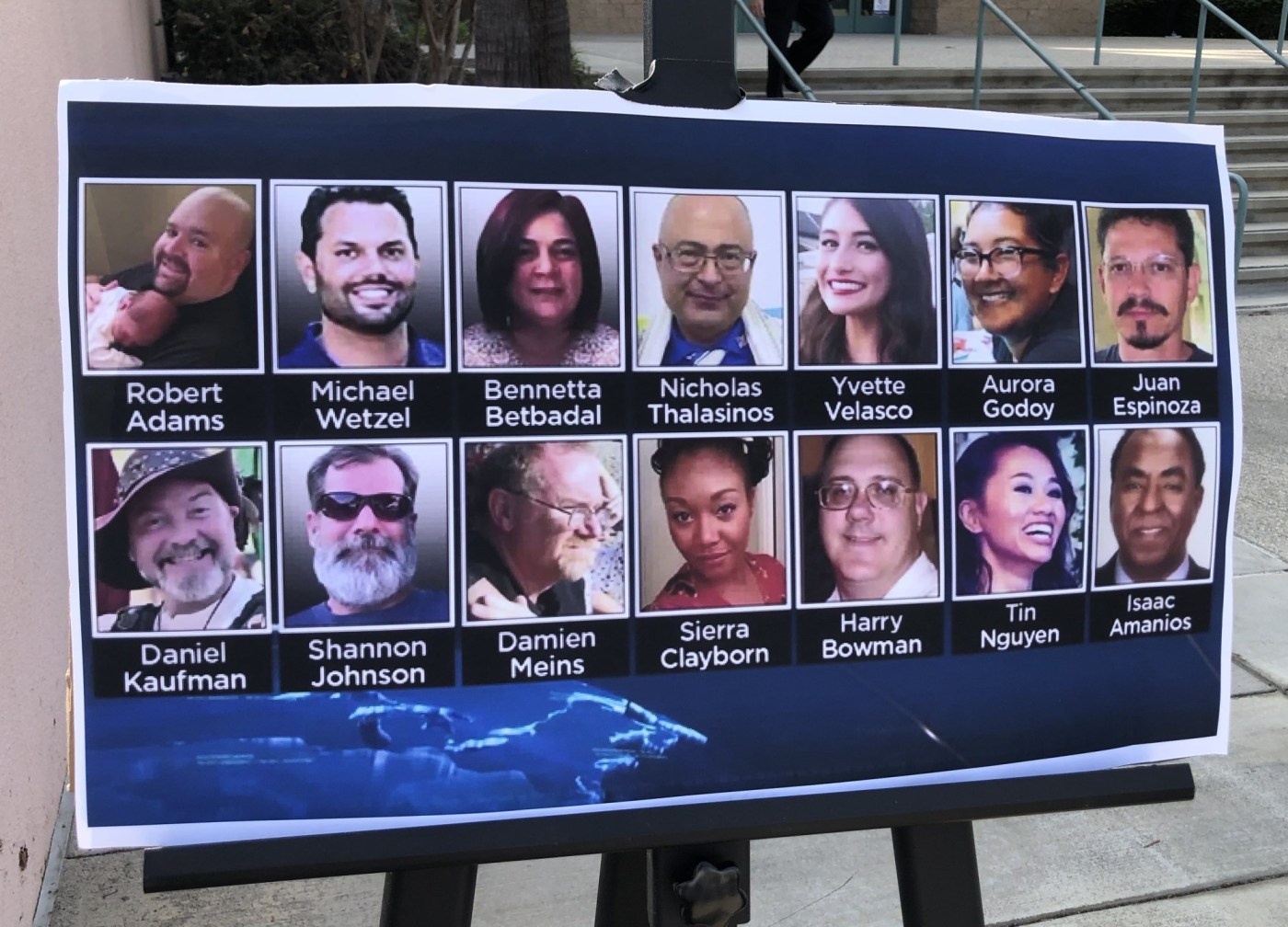
As staff gathered in front of a Christmas tree for group photos, one employee slipped outside. When he returned, he and his wife wore masks and carried semiautomatic weapons. They opened fire, murdering 14 people, including 13 of his coworkers, and wounding 22 more. The couple died in a shootout with police hours later.
The Dec. 2, 2015 mass shooting at the Inland Regional Center in San Bernardino was the 13th deadliest in American history.
In the decade since, a clearer picture of what led to the shooting has taken shape. Public records and interviews with those most directly affected suggest the San Bernardino mass shooting was both a terrorist act and a workplace shooting.
The attack was committed by a man who had grown up in an abusive home, was radicalized by violent online content, and who had access to high-powered weaponry. Family members of victims say workplace disputes that should have raised red flags were reported to the county.
“There’s always warning signs,” said Ryan Reyes. His partner, Daniel Kaufman, was killed in the attack.
Syed Rizwan Farook, the Environmental Health Services employee who would later open fire on his coworkers, was the son of Pakistani immigrants, born in Chicago but raised in Riverside.
It does not appear that it was a happy home.
Farook’s father was an alcoholic with bipolar disorder who refused to take prescribed medication, according to his mother.
“He is always mad. Drinking all day. Screaming on me, shouting at my kids for no reason,” Rafia Farook wrote in a 2006 request for a restraining order. “That day he tried to hit me. I do not know exactly why he was mad.”
Her children had to interpose themselves between their parents to stop their mother from being attacked, Rafia Farook wrote. Her husband would throw things, including dishes. He’d scream at the family and regularly threaten to kill himself. At least once, in February 2008, he was held in a county hospital for a 72-hour observation period, court documents show.
The couple divorced in early 2015.
According to the online mass shootings database The Violence Project, at least 70% of mass shooters have experienced significant childhood trauma.
“Parental suicide is common, as is physical abuse, sexual abuse, domestic violence in the home, and severe bullying by classmates,” the founders of The Violence Project, Jillian Peterson and James Densley, write in their 2021 book, “The Violence Project: How to Stop a Mass Shooting Epidemic.”
“This early exposure to violence and unaddressed trauma feeds the perpetrator’s rage and despair later in life,” the pair write. “Mental health concerns such as depression, anxiety, and paranoia commonly develop during adolescence and are rarely identified or treated.”
Syed Farook, a devout Muslim, fantasized about committing violence of his own, inspired by terrorist groups that claimed they fought on behalf of Islam. He eventually shared those fantasies with his neighbor, Enrique Marquez Jr., according to a 37-page criminal complaint filed by the FBI against Marquez in federal court two weeks after the attack.
Marquez had moved in next door to Farook’s family in 2004. Marquez, 14 at the time, hung out with Farook, then 18, while the older teen worked on cars in his driveway.
“Shortly thereafter, Farook introduced Marquez to radical Islamic ideology, which included expressing disdain toward Muslims in the U.S. military that killed other Muslims, and discussing the extremist views of the now-deceased imam and Islamic lecturer” Anwar al-Awlaki, the FBI’s complaint reads in part.
Farook and Marquez also read Inspire, the official online magazine of terrorist group al-Qaida, according to the complaint. The summer 2010 edition included instructions on how to build radio-controlled pipe bombs and called on readers to destroy the United States.
In 2011, the neighbors talked about attacks “designed to maximize the number of casualties,” according to the FBI complaint.
Maybe they could throw pipe bombs into the library or the cafeteria at Riverside City College.
Or maybe they could bomb the 91 Freeway during rush hour along a stretch near Corona that had few exits people could use to escape. Then Farook would move through the stopped cars, shooting trapped motorists, while Marquez shot first responders.
In November 2011 and February 2012, Marquez bought two AR-15 semiautomatic rifles. The day after the Inland Regional Center attack, he told a 911 dispatcher the guns had been used in the shooting in San Bernardino. Marquez later told the FBI the firearms were specifically bought to attack Riverside City College or the 91 Freeway. Separately, Farook bought two semiautomatic handguns.
In November 2012, the FBI arrested four Inland Empire men who had been plotting to join the Taliban and al-Qaida and kill or kidnap Americans overseas. Like Farook and Marquez, they had trained at Los Angeles-area paintball and gun ranges.
According to the criminal complaint against Marquez, the arrests spooked him. He pulled away from Farook and out of the plans to commit violence.
But Farook seemed undeterred.
He began looking for a wife online. He matched with Tashfeen Malik, who was studying at a religious school in Pakistan.
The pair were “radicalized before they ever started courting or dating online,” then-FBI director James Comey told the Senate Judiciary Committee a week after the attack. “As early as 2013, they were speaking about jihad and martyrdom before they became engaged.”
After connecting via Skype, Farook and Malik finally met in person in October 2013, when he was on pilgrimage in Saudi Arabia. They got engaged the same day. In July 2014, Malik moved to the U.S. The couple later moved into a Redlands townhouse.
The pair had a baby girl six months before the mass shooting. They left her with Rafia on the morning of Dec. 2. They told the girl’s grandmother they had a doctor’s appointment. (Farook’s sister, Saira Khan, sought to adopt her niece after the shooting. The Riverside County Department of Public Social Services would not disclose where the child was placed, citing California’s confidentiality laws surrounding adoption.)
Malik practiced an extremely conservative form of Islam.
“(Redacted) asked to see a picture of his wife but Syed refused, explaining that she wears a religious head covering,” one of Farook’s coworkers said in an FBI interview. “Syed told (redacted) that he was still living with his family in Riverside. He explained that things were tense in the house, as his parents were not into the fact that his wife wore her head dressing ‘24/7,’ even in the house. Despite that, Syed said he was happy.”
Former San Bernardino Police Chief Jarrod Burguan told ABC News in 2016 that Malik had posted online that she did not believe Muslims should be required to participate in non-Muslim holiday events.
The environmental health services’ 2015 general education meeting was officially a training event, not a Christmas party. Employees told the FBI that past meetings had featured fall themes, with scarecrows and hay bales. And although past meetings had been mandatory, the 2015 meeting was not. But not all employees knew about the change, according to FBI interviews.
On the morning of the attack, as Farook and Malik drove to the Inland Regional Center, Malik searched social media for materials related to the terrorist group ISIS, according to the criminal complaint against Marquez.
As the couple fled after, she pledged the couple’s allegiance to ISIS leader Abu Bakr al-Baghdadi in a Facebook post.
Farook’s and Malik’s accounts were deleted by Facebook soon after.
Three days after the attack, ISIS called the pair “supporters” of the group in a radio broadcast.
In the end, the FBI ruled that Farook and Malik were homegrown terrorists.
“As of today, we do not see any indications of a foreign-directed terrorist act,” David Bowdich, Assistant Director in Charge of the FBI’s Los Angeles field office, said at a January 2016 news conference. Instead, the couple appeared to have been self-radicalized by online materials, like Inspire magazine and Anwar al-Awlaki’s speeches.
ISIS has urged the group’s followers to “direct your actions at the easy targets before the difficult, the civilian targets before the military, and the religious targets such as synagogues and churches before anything else,” as a spokesman said in a January 2024 speech.
But Farook and Malik didn’t choose a target with obvious political or religious significance. They targeted Farook’s coworkers.
Workplace shootings are the most common type of mass shooting. More than 29% of mass shootings in the Violence Project database are classified that way. That includes the attack at the Inland Regional Center, which the database also classifies as terrorism.
Farook worked as a health inspector for the environmental health services division for five years.
“Nothing at work gave (redacted) the impression that ‘this,’ meaning the shooting at the (Dec. 2 general education meeting), could happen,” an employee told the FBI in interviews after the attack. “Farook was a ‘typical’ employee; he did not stand out in any way.”
Farook’s coworkers never met Malik. But they threw a baby shower for the couple’s daughter months before the shooting.
Still, there were signs of trouble at work.
“Approximately three months ago, Farook’s demeanor changed,” a coworker told the FBI a week after the attack. Other interviewees made similar remarks. “He showed ‘no reaction at all’ when (redacted) greeted him. When (redacted) said ‘good morning’ or ‘hello’ to Farook, Farook would look at (redacted) but not respond in any way or acknowledge the greeting. (Redacted) would wonder to himself ‘did he hear me or what?’”
Farook also reportedly had a workplace conflict with at least one coworker.
“County knew that its employee Syed had a heated and volatile argument with a co-worker over the Islamic religion and faith,” an August 2017 claim filed on behalf of the relatives of three employees killed in the attack reads in part. “County knew or should have known that its employee Syed was predisposed to commit acts of violence and thus maintained a hostile work environment.”
Trenna Meins is the widow of Damian Meins, one of Farook’s coworkers who was killed at the Inland Regional Center.
In fall 2015, Trenna Meins was the principal of Sacred Heart Parish School in Rancho Cucamonga.
According to the county Department of Public Health, another of Farook’s coworkers, Nicholas Thalasinos, inspected the school’s kitchen on Oct. 8, 2015, less than two months before the San Bernardino attack.
“In our conversation about the kitchen, (Thalasinos) brought up the terrorist attack on the train in Paris,” Trenna Meins said, referring to the Aug. 21, 2015 shooting of four people on a train traveling from Amsterdam to Paris. Passengers subdued the gunman, who was linked to ISIS.
“And (Thalasinos) told me that he had a guy in his office, Farook, that defended the action of the terrorist,” Meins said. “So those two had an argument.”
Before his death in the attack, Thalasinos had a fiery online presence. Calling himself “ProTzionist” on his two Facebook accounts, he attacked those he saw as antisemites or enemies of Israel.
“The LIBERAL FASCISTS running America and Europe have this DELUSION that if they SACRIFICE INNOCENT JEWS on the PAGAN ALTER to the ADVERSARY and it’s Antisemetic CULT ISIS et al – the CULT will SPARE the LIBERALS,” he posted on his Michael Thalasinos account on Nov. 14, 2015.
Thalasinos’ widow declined to be interviewed for